We are all aware that Manchester United has a problem since 2013. The day that Sir Alex Ferguson left United is the day that the club began to decline to the point that almost every two years a new manager comes in to turn things around. We will have a look at the statistical legacy of Sir Alex Ferguson and try to find out what Manchester United should have done different and what to look out for in the near future. What we are not trying to do is a qualitative approach to what and why. For sure there are good reasons to combine a qualitative approach together with this quantitative one but that is for other to do.
The focus is on the Premier League only as the success is in the Premier League equals to the overall success of the season. Yes, a team can win the Champions League and end 7th in the league but this would generally speaking no be considered a ‘successful’ season if the club ought to end in a top three position. There are more of such scenarios in which some people would claim that winning a cup automatically means ‘success’ but overall we see that there is pressure to finish in the top X,Y, or Z in the league. I will also NOT focus on the exact ranking but instead on the points average of that season to show progress, or decline. This way we can compare the results of season X to season Y.
We can see from the data that Sir Alex Ferguson had some low output regarding AVG points per game between 1986-1992, with the exception of season 1987–1988 (from now on we will call this “AvgPPG” = points total end of season / games played per season). That is five full seasons in which AvgPPG was below the 2.0. In modern day football such results would get you fired within 3 seasons. However, Sir Alex Ferguson was given the time to start and finish his project:
Data set of low output seasons
Start: 1986 – 1987
End: 1991 – 1992
total sum AvgPPG = 9.73 / seasons (6) = 1.62 AvgPPG
One should do qualitative research to why Sir Alex Ferguson never was fired during that period. One answer is that during the 1991-1992 season they finished second in the league and that the league structure was different. However, the two seasons prior were just bad, and one season prior to that they ended second (1987–1988).
Nevertheless, between season 1992–1993 and 2012–2013 Sir Alex Ferguson always had a AvgPPG of at least 1.97. But let’s visualize it so that you can see it.
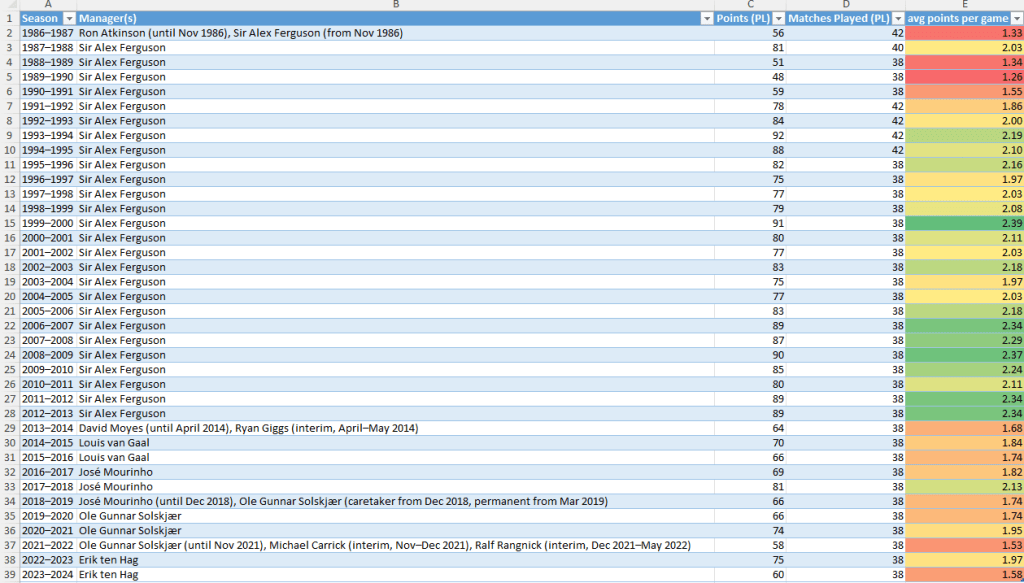

We can see that from season 2013–2014 Manchester United declined significantly. This was also the season that Sir Alex Ferguson was not a Manchester United manager anymore. The only successful season after the Sir Alex Ferguson period was 2017–2018 in which José Mourinho managed the club with a AvgPPG of 2.13. Here we can make the argument that Mourinho should have remained at the club for at least two more seasons.
The conclusion that I draw from this is that managers should be given at least five years to build up something sustainable in order to have potential success. The alternative would be something really ‘fringe’ such as stop hiring managers and only work with the board of a club and the captain of the team. The logic would be; why hire a manager that can’t built something stable while you are paying a lot of money for him (even more if you will release him while under contract).
Download the excel file below:
 DataArion